News Story
UMD Battery Research Lab Presents Discoveries in Two Prestigious Nature Journals
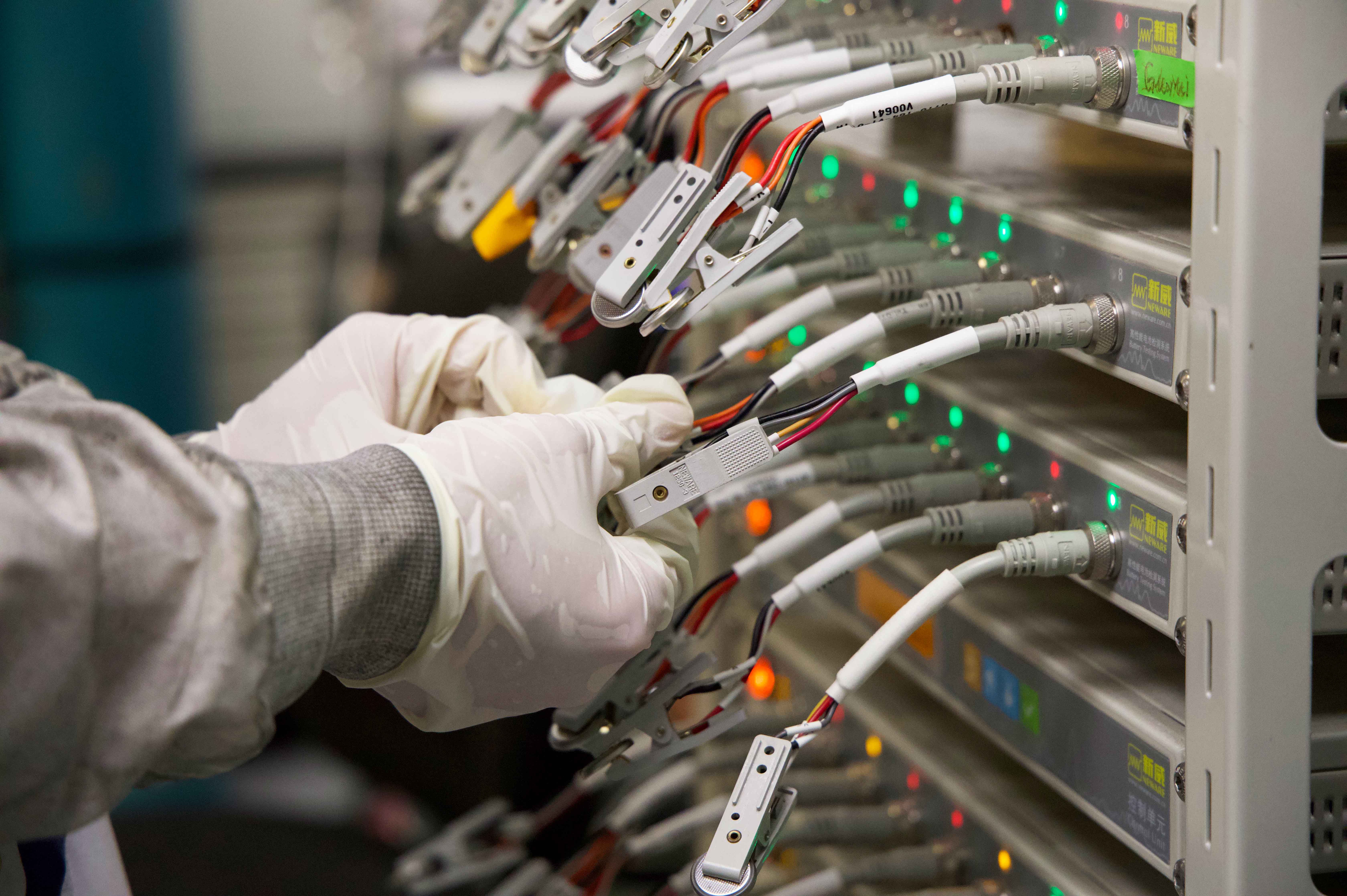
A research team led by Distinguished University Professor Chunsheng Wang in the Department of Chemical and Biomolecular Engineering has presented two discoveries published in Nature journals this month.
The first one, a novel electrolyte system to eliminate long-standing challenges that have constrained the energy, power, and lifetime of advanced high-energy batteries, was published in Nature Chemistry today.
For decades, the success of lithium-ion batteries has relied on the formation of solid electrolyte interphases on anodes through electrolyte reduction. This process stabilizes low-potential anode materials such as graphite, silicon, and lithium metal. In contrast, on the cathode side, interphases have traditionally formed through electrolyte oxidation, producing porous and unstable cathode–electrolyte interphases. These unstable layers accelerate transition-metal dissolution, oxygen evolution, and long-term performance decay, becoming a key bottleneck in the development of high-energy batteries.
“To fundamentally solve this problem, we needed to reverse the long-standing belief that electrolyte reduction cannot occur on cathodes,” said Wang.
To overcome this challenge, the team developed an electrolyte reduction strategy, which elevates the reduction potential of electrolytes to an unprecedented 2.4–4.2 V. By regulating the molecular-level electrolyte reduction processes, the researchers achieved unprecedented control over cathode interphase chemistry.
This innovation breaks the long-standing trade-off between energy density, power output, and cycling stability, that could either enhance the energy and power of primary batteries or extend cycle life in rechargeable batteries. Technology shows strong potential for applications in electric aviation, spacecraft, and other extreme-environment energy systems, where both ultrahigh energy density and high power are essential.
The second paper achieved a breakthrough in sodium metal battery technology, introducing an eco-friendly electrolyte design that enables sodium batteries to match the energy density metrics of conventional lithium-ion batteries, while delivering significant advantages in cost reduction and environmental sustainability. The findings were published in a paper in Nature Sustainability in early December.
Sodium, a globally abundant alkali metal, boasts a crustal abundance over 1,000 times higher than lithium and is uniformly distributed across continents, from seawater to common mineral deposits. This inherent availability eliminates supply chain risks and resource scarcity constraints plaguing lithium-ion battery production, promising substantial low costs for large-scale energy storage applications.
For decades, however, sodium metal batteries have been hindered by critical performance bottlenecks in energy density and cycle life, as conventional carbonate electrolytes often suffer from poor electrochemical stability, leading to rapid electrode degradation and premature battery failure.
In this paper, Wang’s research team addressed this challenge through a sustainable electrolyte design that eschews fluorinated solvents, which are widely used in electrolyte development and pose significant ecological risks during production and disposal.
The newly developed electrolyte overcomes sodium metal batteries’ core limitations by facilitating robust interphase formation and efficient ion transport, enabling stable high-power charge, and extending long-term cyclability.
The technological breakthrough hinges on a precision molecular modification of the electrolyte formulation. This tailored chemical design induces the in-situ formation of a robust, protective interphase layer on both the cathode and anode surfaces. This adaptive interphase effectively suppresses two major failure mechanisms in sodium metal batteries: the growth of harmful sodium metal dendrites and the generation of toxic/flammable gaseous byproducts.
“This result fixes the problem holding sodium batteries back for years,” said Wang. “We now might have a battery as powerful as lithium, but cheaper, more abundant, and planet-friendly, which is ideal for EVs, grid storage, and more.”
Published December 19, 2025
Recent Stories
Stories / Oct 23, 2026
Meet the Clark Scholars Class of ’30

Stories / Oct 5, 2026
Celebrating LGBTQ+ History Month 2026

Stories / Oct 1, 2026
Kelly M. is Learning (and Advocating for Students) by Doing

Stories / Sep 22, 2026
Two Years Running, Maryland #12 Among Publics for Undergrad...

Stories / Sep 15, 2026
Honoring Achievement: Celebrating Latine Heritage Month

Stories / Sep 15, 2026
Tabatha Cuadra Rodriguez: Community Advocate

Stories / Sep 14, 2026
ACS Recognizes Chemical Engineer with Leadership in Mentorship...

Stories / Sep 10, 2026
University of Maryland Researchers Develop Three Materials...

Stories / Sep 3, 2026
UMD Convocation will honor five from the Clark School

Stories / Aug 27, 2026
Maryland Engineering Student Organizations (MESO):...
